


We interviewed four Bandai Namco Studios (BNS) server engineers, each developing games in different capacities, why they chose the company and what roles they play.
In part 1, we’ll take a look at their job histories, why they chose BNS, and their actual work environments!
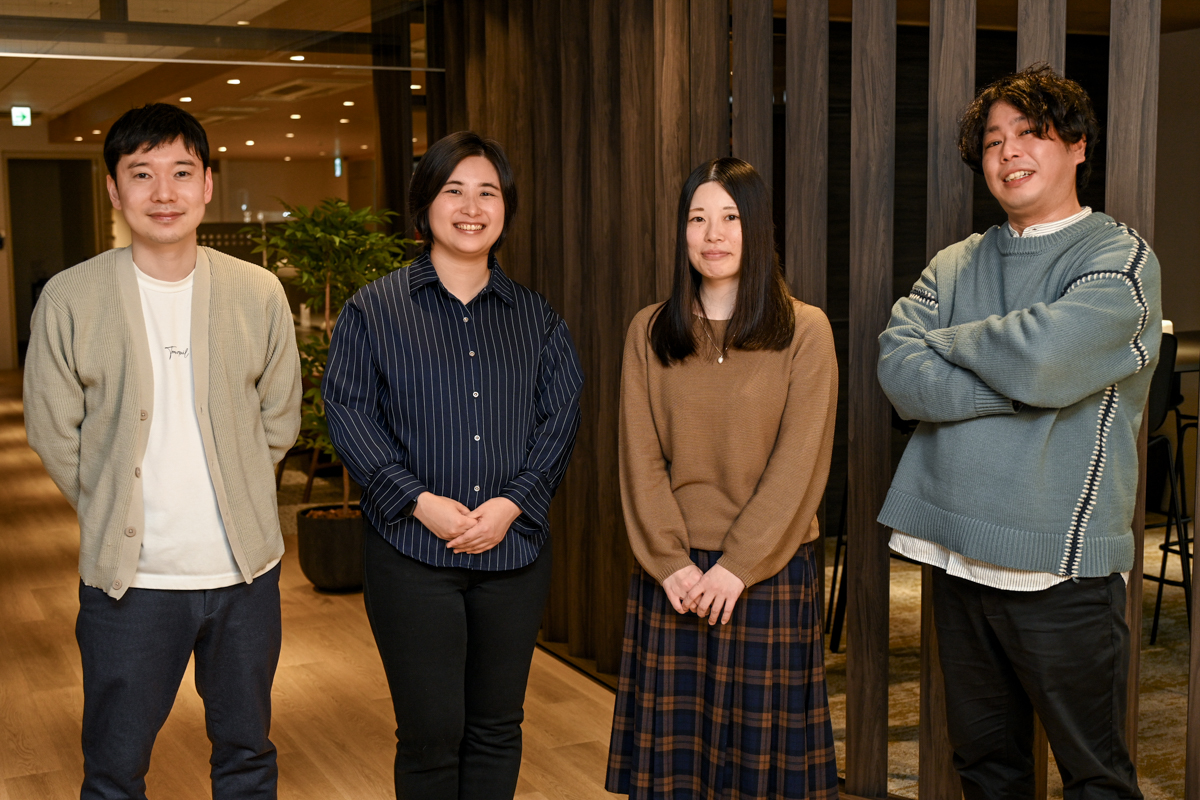
*From the left
Tech Studio, Group 2, Common Infrastructure Development Department, Online Tech Section
Tetsuro Aoki / Yee Ting Ho / Fuka Amano / Yusuke Matsushima
*BNS will be used in place of Bandai Namco Studios for the rest of the article for brevity.
―Tell Us About Your Current Main Duties.
Aoki: I work on console games as something like the server-side Tech Lead. My team handles everything server-related for the project, such as setting up infrastructure, developing server applications, CI/CD, and even developing project management tools.
Ho: I develop server infrastructure used by multiple projects, help new projects get set up, and work with external developers, so I play a cross-organizational role.
Amano: I work on console games as a technical director for online features. I’m in charge of server functionality so I have to be on top of project progress, revise schedules, and meet with other disciplines so we all stay on the same page.
Matsushima: I’m on a project for an online competitive game, and I coordinate the companies developing the game client and server-side features, providing them with technical support. I solve problems through my experience as both client engineer and server engineer.
A Variety of Backgrounds: Arts Students, Experienced Leaders, and Even Client Programmers!?
―Amano-san, Ho-san, and Matsushima-san are all mid-career hires, so what kind of jobs did you have before BNS?
Amano: My last job was at another game company, where I worked on server programming for arcade games. I was in charge of developing APIs and companion websites, and there were times when I was assigned to multiple titles at the same time.
But I didn’t always work at video game companies, and I didn’t even go to school for engineering. I was an arts student who studied Japanese literature and only started pursuing engineering after I started working.
I built up experience working on server-side technologies, gained skills through trainings and practical application, and am now at BNS after working at several other companies.
Ho: Before I came to Japan, I did both client and server programming at a small-scale game company. I then got interested in server engineer work, so the next job I applied for was for a server engineer position at a Japanese company.
My previous company had me work on development and operations on a live service game, and I also have experience as a lead engineer.
Matsushima: I was a client engineer on a mobile game. But I also worked on server and infrastructure things, so I was able to have a relatively broader range of experiences.
My experience has given me a mindset to develop projects wholistically as “a game” instead of separating things between client and server, and I apply this type of thinking to my work even now.

Choosing BNS: The People and an Environment Where You Could Try New Things
―What was your reason for wanting to work at BNS when you were job hunting?
Amano: A BNS employee I talked to during a game industry event was very polite and left a good impression on me, and wanting to work with someone like them was my reason for applying.
At the time, I was job hunting with the intent of working in a different environment, and I was particularly focused on the people and company atmosphere as I had already experienced working with a variety of teams. It went without saying that I was also interested in the company’s tech and what games they were making, but “who I would work with” played a big part for me.
My first impression of the company was what convinced me to apply, and it didn’t change even after I started working here.
Ho: For me, a big part was because I heard that the company did server development for console games.
Most of my experience back then was working on live service titles, so even though I had experience as a server engineer, none of it was on creating online experiences only possible with a console game.
I genuinely thought it was a new and interesting challenge to pursue, which is why I applied.
Matsushima: My main reason for changing jobs back then weas because I wanted to try working on bigger projects than what I had experienced up until then. I applied to BNS because I wanted to be involved in a big project with many people, and to try my hand at the difficult technologies unique to console game development.
Another big motivator was that BNS made the games that I liked, so it was nice to be able to participate in the development of games that I played and IPs that I liked.
I felt like I could further my career by working with highly specialized technology used in console games, bigger teams, and the chance to work on my favorite games. These were the reasons why I chose BNS.
The Appeal of Working at Bandai Namco Studios
―Tell us about your impressions of BNS after you started working here.
Amano: The people here are genuinely good people. They’re kind, diligent, many of them are sincere, it’s an environment you can work in with peace of mind. The recent company Family Event was very comfy, and even on the day-to-day, the people I work with often come across as nice people.
It may sound like I’m lying with how much praise I’m showering the company (laughs), but working here didn’t change my expectations of the company, and it’s a very good environment to work in.

Ho: The company was exactly what I expected as well. I felt like it was environment where I could take on new challenges.
For example, features like matchmaking, observing, or player lobbies required that more data be communicated in real-time compared to live service games, and that even slight lag or instability has a direct effect on the game’s experience. It is highly interesting to handle such difficult technical topics.
The server-side engineers also have a lot of agency, to the point where we can adopt any technology we want as long as there is a valid reason for doing so. Of course, there are licensing or project limitations we need to keep in mind, but we can consider and propose the libraries and infrastructure we think are appropriate for the project. It’s a good work environment.
This is related to what Amano-san mentioned, but many people here are capable of understanding the words of others. This makes work go along a lot more smoothly. It’s reassuring to know that you can have a genuine conversation about technology and game-making with the people here.
Matsushima: I feel that’s the case as well.
I also felt that the other engineers here were very skilled, and it’s not just being knowledgeable, they all have their particular commitment to their work. My impression was that many of these video game engineers seemed proud of their work.
Another difference from my previous job was the scale of the project. A big project means that one single engineer is assigned to more granular features, making it more opaque as to what the person next to you is working on. It reminded me of the importance of having a leader who can keep a broad perspective especially when working as a big team.
It’s not an easy job, but it achieved my aspiration to work in a big team.
Customer reaction grows the bigger the game or the more famous the IP, and the sense of accomplishment when you finish development also grows as well. It’s difficult but rewarding.
―Thank you all for your time!
In Part 2, we’ll go into details of the job, what makes it appealing, and the special care each of them puts into what they make.
▶ [Part 2] Dedication to and the Appeal of Work, and the Pursuit of Fun



