


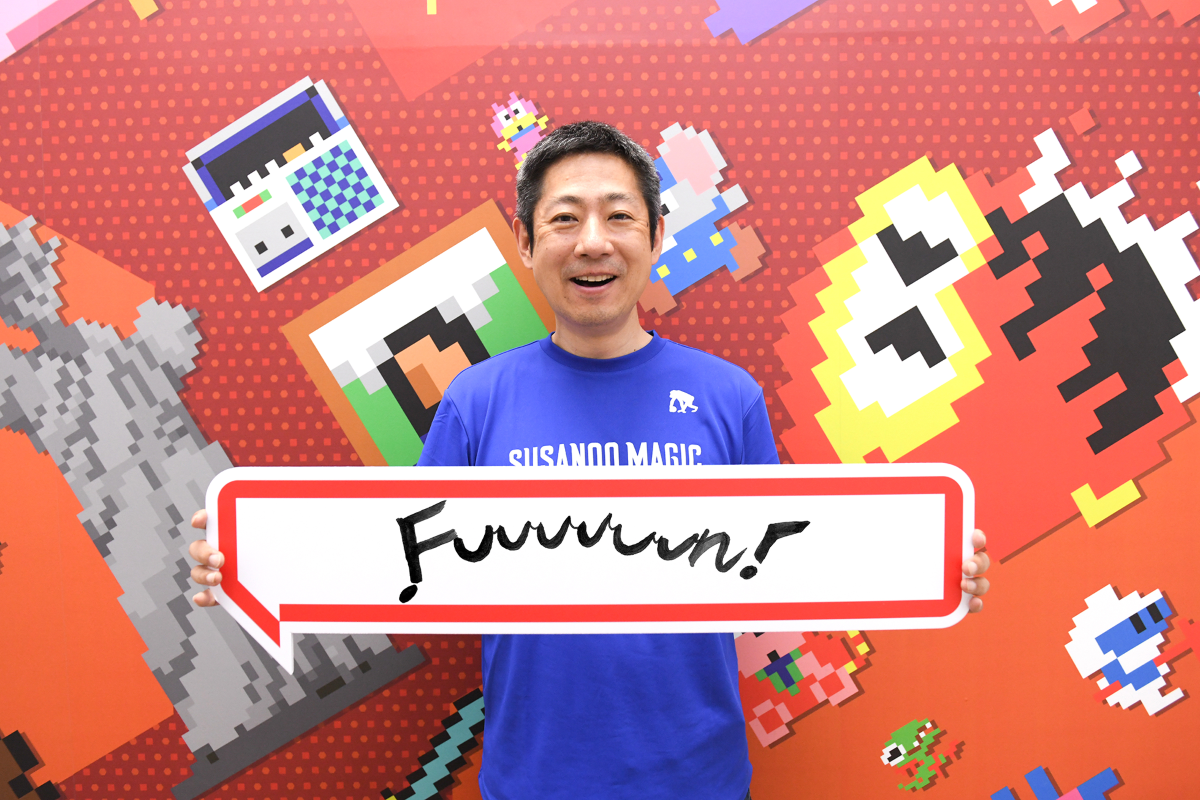
Sound Director Yoshihito Yano
―How did you come to join Bandai Namco Group?
Even as a child, I remember being hooked to copying pop music and game scores and playing them by ear, which eventually led to joining the band circle in college. Of course, I wrote my own music back then, but I’m particularly fond of a memory playing PlayStation®’s Ridge Racer right after its release. I crammed into a kotatsu with five of my friends from school, and we took turns playing and napping—before we knew it, 25 hours had passed. Obviously, we were exhausted by the end, and I remember thinking, “Man, Namco makes some captivating games!”
That experience led me to pursue a career that combines music and games. When I applied for Namco, I did it for fun and never expected to get hired, but as it turns out, I got very lucky.
I want to make a fan out of everyone I meet through work and everyone that hears my music
―Which titles have you written music for so far?
My debut was in the skiing game Alpine Racer 2, for which I created the sound effects.
I recreated the experience of skiing by expressing the sound of wind hitting your ears and buzzing by with the synthesizer, and with respect to sound effects for gliding and jumping, I adjusted the volume and key to depict the player’s speed, and so on. I found it fun to play around and devise different ways to create sound effects.
Afterwards, I went on to create sounds for various projects, like Soulcalibur, Katamari Damacy, Taiko no Tatsujin, and The iDOLM@STER. More recently, I have written music for Aqua Magic, the official cheer squad of the Japanese professional basketball team Shimane Susanoo Magic, and have also worked as the Sound Director for Katamari Damacy Rolling LIVE.
―What was a turning point or a particularly memorable experience in your career?
In the game Katamari Damacy released in 2004, I wrote the ending theme song that plays during the ending credits, a ballad titled “Katamari of Love.” This work is particularly memorable because in addition to writing the lyrics, music, and arrangement, we recorded the vocals and recorder performance together with other Group members. Most of all, this project left an impression thanks to the lead vocals, performed by the great Shigeru Matsuzaki. He was the same entertainer in person as the one you regularly saw on television, and he was always livening up our staff during production. I was moved by his professionalism—he was constantly thinking of how to entertain people, whether it was staff on site or fans beyond the screen. It elevated my own approach to work and led me to desire making a fan out of everyone I meet through work and everyone that hears my music.
I heighten my senses and observe my surroundings on a regular basis to transpose everything I encounter into sound
―What are you particularly mindful of when creating music? Please share any methods or approach that might be unique to you.
I try to transpose everything I encounter in life into sound—occurrences in daily life, beautiful scenery before my eyes, visual works I’ve watched… This is why I’m mindful to heighten my senses and observe my surroundings carefully on a daily basis. For example, I may test how much sound is absorbed in conference rooms to check the level of reverberation, or clap my hands in rooms to check the resonance frequency. I also do this whenever I pass through a tunnel—sometimes I think, “Wow, I like this tunnel. It creates sound that has richness to it.”
I used to do judo in high school, which also lends to my musical sense as a writer. In Judo, you use force to your advantage in every technique. I often imagine the center of gravity moving in judo and incorporate them into my songs. During sections that involve emotional heightening like the main chorus, I envision stepping strongly into the tatami mat. In other sections that evoke a sense of discomfort like the bridge, I express the shifting center of gravity through the rhythm.
Cuisine also feels similar in a sense. For example, you have umami as the base with elements of spiciness or sourness, then there’s texture, or even the way you feel after you’ve had a few drinks—the way space expands feels similar to echoing. Just like these aren’t particularly visible experiences, expressing things unseen is similar to writing music. I’m constantly pondering these things, so I could never grow tired of this work. (Laughs)
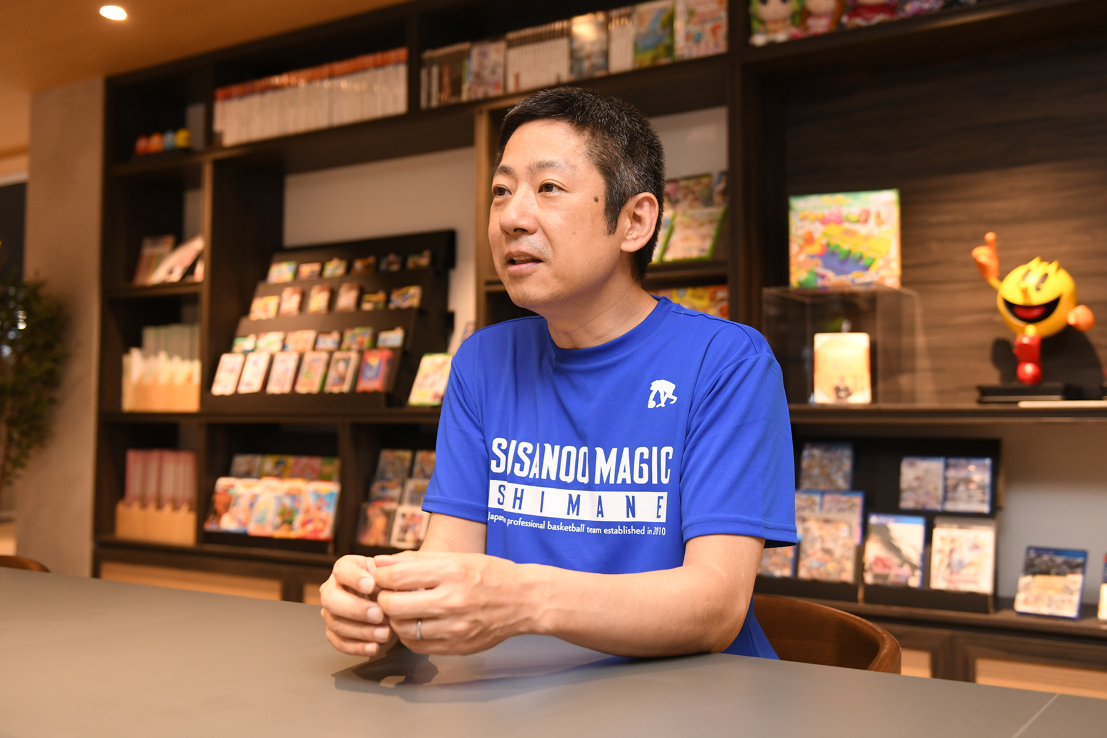
―You’ve developed sounds for Bandai Namco Group’s Sound VI and distribution motion logo, which is played at the beginning of visual works like movies. You’ve also written music for our business introduction video (titled “Fun for All into the Future”). With the video music, the team reached a unanimous decision the moment they heard your sound.
Really? I’m glad to hear that!
Reflecting back on the business introduction video, I actually created a simple choreography for the Purpose’s message of “Much broader. Even deeper. More dreams, fun, and inspiration…” while reciting it myself. After that, I analyzed what kind of sounds comprises the words of our Purpose, and thought about the melody born from the ring of “Bandai Namco.” Eventually, I began to believe that the words “Bandai Namco” is music in and of itself. At times, I would take a stroll at night and murmur, “Bandai Namco. Bandai Namco.” I took these experiences and created the song’s melody.
The Sound VI is one second long, but I adjusted it so that it feels fun and vibrant no matter the environment. As a result, it became: D♭, E♭, C, B♭, A♭. The reason why I landed on a melody with so many flat notes was because I thought it best reflected people’s warmth and depth.
I created this year’s new distribution motion logo sound with the image of sound filling a space—something that’s refined like a scent spreading in the air—based on the fact that it will be played in movie theaters together with a wide variety of contents.
Check out the process behind creating the VI sound effects here!
Creation Process: Samples
Creation Process: Edit to create more liveliness
Final Version
Music for “Fun for All into the Future” is available within the Group Navigation Website under the BNHD website
https://www.bandainamco.co.jp/group/index.php
“Fuuuuuun!” represents how fans exist no matter where you look, just like how Kintaro candy shows its pattern no matter where it’s cut
―It’s very moving to hear you express in words your songwriting process!
―I understand you face this question in your songwriting work, but can you share what “Fun for All into the Future” means to you?
Just as I expressed through my music, I envisioned fun that connects and spreads among fans to go on and on forever. This includes the source of our idea of “Dreams, Fun, and Inspiration,” as well as our creative processes, and of course, our achievements. It’s a cycle where we share them with fans, and fans exist all over, and we connect fun together as if to draw an arch, which will then be delivered to fans over and over again. Our fans exist anywhere, no matter where you look—just like how Kintaro candy shows its pattern no matter where it’s cut. I expressed this with my slogan of “Fuuuuuun!”
Connecting “Fuuuuuun!” means that we have fun working at the Sound Team, and the Group will have fun, too.
And the sound of “fu” has a soft, fun ring to it. I believe this slogan represents the connection between songwriting, music, and short sounds.
―“Fuuuuuun!” has such a great ring to it—I can envision it reaching far in the distance, even to those very far away!
―Finally, can you share with readers what you’d like to tackle next?
I hope to utilize the skills I’ve learned so far in creating music and sound effects and apply them to other processes accordingly. To provide an example, perhaps I can use sound as the key ingredient to integrate something new into mixed media projects (like a crossover between anime and games, for instance). Another example would be to link gaming technology with theme park attractions. Whatever the genre, I’m looking forward to brainstorming new ideas and shifting my knowledge into new realms.
And if that’s the case, the title of Sound Creator might not quite fit anymore—it might be more appropriate to work without a definition of work duties, or even a professional title, for that matter. Rather than treading along a defined set of rails, I think the potential of “Fuuuuuun!” can be fully realized by joining a project that would allow me to create my own path.



